November 05, 2025
|10 นาที

ฟีเจอร์ใหม่ของ Search Console Insights ไม่ใช่แค่การรายงานที่เป็น “การทำความสะอาด” เท่านั้น สำหรับนักการตลาด B2B มันคือสัญญาณเชิงกลยุทธ์ที่ขับเคลื่อนด้วย AI เพื่อระบุความต้องการของผู้ซื้อที่มีความตั้งใจสูงและแนวโน้มตลาดที่กำลังเกิดขึ้น
Google ได้แนะนำฟีเจอร์ “Query Groups” ใน Search Console Insights เมื่อเร็วๆ นี้ โดยระบุว่าเป้าหมายคือทำให้รายการคำค้นที่ยาวและรกอ่านได้ง่ายขึ้นโดยการรวมเจตนาผู้ใช้งานที่คล้ายคลึงกันเข้าไว้ด้วยกัน
สำหรับนักการตลาด B2B ที่ทำงานกับคีย์เวิร์ดที่มีการพิจารณาสูง ปริมาณน้อย และความตั้งใจสูง คำว่า “น้อยลงน่าเบื่อ” ถือเป็นการประเมินที่เกินจริง นี่ไม่ใช่แค่การทำความสะอาด—มันเป็นคริสตัลบอลที่บอกอนาคต
ความท้าทายที่เรายังคงเผชิญคือการรวบรวมคำค้นแบบยาว (long-tail) ที่แตกกระจายเพื่อทำความเข้าใจว่าผู้ซื้อที่ซับซ้อนจริงๆ ต้องการแก้ปัญหาอะไร จนถึงตอนนี้การทำเช่นนั้นต้องการการวิเคราะห์ด้วยตนเองที่ช้า
ด้วยการอัปเดตนี้ AI ของ Google สามารถทำงานหนักแทนเราได้ โดยเปลี่ยนงานของเราจากการรายงานคำค้นไปสู่การวิเคราะห์เจตนา—ก้าวสำคัญที่ทำให้ SEO ของ B2B ข้ายหน้าไป
ก่อนที่เราจะเข้าสู่กลยุทธ์ มาทำความเข้าใจว่าอัปเดต Query Groups คืออะไรจริงๆ.
ตามประกาศของ Google ฟีเจอร์ใหม่ “Queries leading to your site” ใน Search Console Insights จะกำหนดให้: Group Similar Queries: มันใช้ AI เพื่อรวมรูปแบบคำค้น (การสะกดผิด ขึ้นคำใหม่ๆ ที่สะท้อนเจตนาผู้ใช้ที่คล้ายกัน) เข้าไว้ใน “กลุ่ม” เดียว หมายเหตุ: กลุ่มถูกคำนวณแบบไดนามิกและอาจเปลี่ยนแปลงได้ โดยไม่มีผลต่ออันดับการค้นหา Show Group Performance: แทนที่จะเห็นคลิกของคำแต่ละคำ คุณจะเห็นคลิกทั้งหมดของกลุ่มนั้นๆ ซึ่งมอบมุมมองระดับสูงที่แม่นยำกว่า Provide a Drill-Down: นี่เป็นกุญแจสำคัญ คุณสามารถคลูกรวมกลุ่มเพื่อ “ไปที่รายงานประสิทธิภาพเพื่อดูคำค้นย่อยทั้งหมดที่ประกอบเป็นกลุ่มนั้น” Spotlight Trends: การ์ดจะแสดงทันทีว่า กลุ่มใดอยู่ในระดับสูงสุด (Top) ตามปริมาณ, กำลังขึ้น (Trending up) และกำลังลง (Trending down) โดยมีให้เฉพาะเว็บไซต์ที่มีปริมาณคำค้นสูงเท่านั้น จะเผยแพร่แบบขั้นตอนต่อเนื่องในสัปดาห์ที่จะถึง 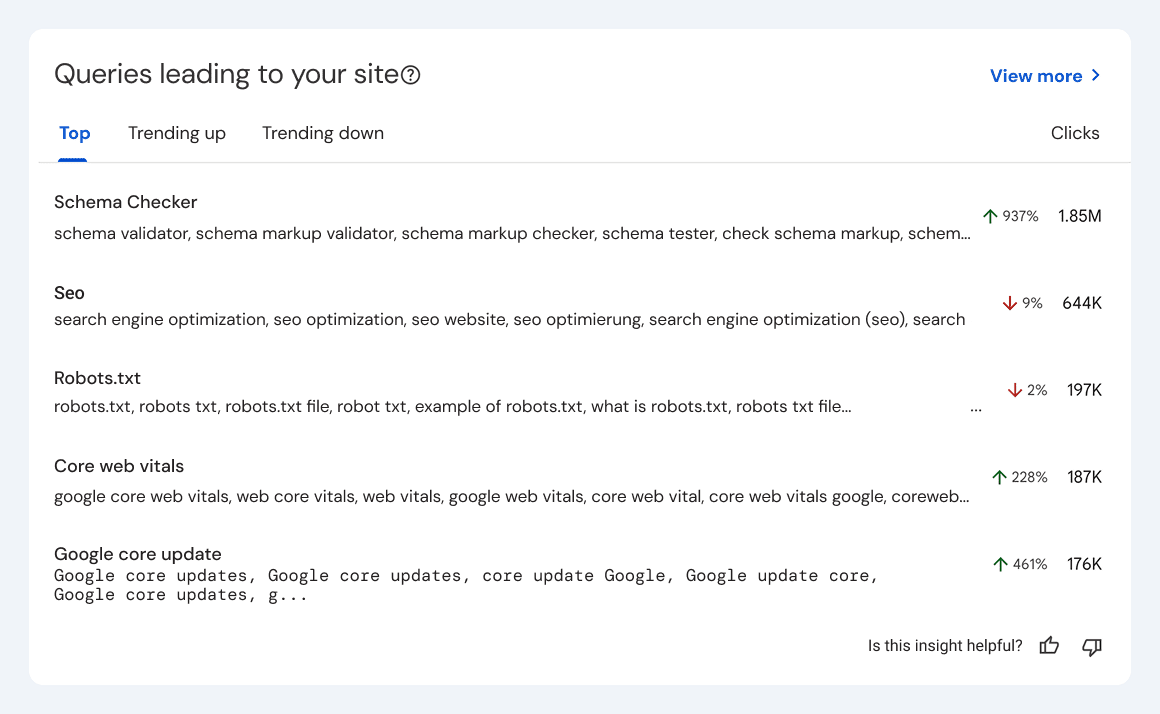 Image source ตอนนี้หลังจากที่เราได้ครอบคลุมพื้นฐานแล้ว มาดูกันว่า ฟีเจอร์เหล่านี้หมายถึงอะไรสำหรับนักการตลาด B2B.
What Google Says: “Query groups แก้ปัญหานี้ด้วยการรวมคำค้นคล้ายๆ กันเข้าไว้ด้วยกัน… พวกมันสะท้อนเจตนาผู้ใช้งานที่คล้ายกัน” เป็นเวลาหลายปีที่การประชุมเกี่ยวกับกลยุทธ์เนื้อหา B2B มักมีการถกเถียงเรื่องโครงสร้างมากที่สุด “นี่ควรเป็นหน้าพินเดียวขนาดใหญ่ หรือห้าบทความบล็อกที่แยกกัน?” เราเคยผ่านสถานการณ์นั้น SME ของคุณยืนยันว่า “kubernetes cost monitoring” และ “finops for EKS best practices” เป็น แตกต่างกันโดยสิ้นเชิง Your SEO manager, armed with a keyword tool, argues they’re semantically related and should be on the same page to build authority. The result? A compromise that satisfies no one: either a bloated, unfocused “monster” article or five thin, niche posts that compete against each other for the same SERP (a classic case of keyword cannibalization). การอัปเดตนี้ยุติการถกเถียงนั้น Google is now your objective, AI-powered moderator. โดยการรวมกลุ่ม “kubernetes cost monitoring”, “finops for EKS best practices”, and “how to reduce GKE egress fees”ให้เป็นหนึ่งกลุ่มการค้นหา Google ไม่ใช่ “ทำความสะอาด” รายงานของคุณเท่านั้น มันกำลังออกคำชัดเจนเกี่ยวกับเจตนาของผู้ใช้ มันบอกคุณว่า “บุคคลเดิม (ผู้ซื้อที่เป็นไปได้ของคุณ) กำลังค้นหาสิ่งเหล่านี้ทั้งหมดในเส้นทางการแก้ปัญหาเดียวกัน” ฟีเจอร์นี้มอบคุณด้วยกลุ่มเนื้อหาของคุณบนจานเงิน The Old Way (Pre-Query Groups): คุณล็อกอินเข้า GSC แล้วเห็นสิ่งนี้:
Your Action: คุณมอบหมายให้บล็อกโพสต์ 4 เรื่อง 1,200 คำให้กับทีมเนื้อหาของคุณ ทรัพยากรด้านวิศวกรรมของคุณถูกใช้อย่างจำกัดในการเขียนโพสต์เหล่านั้น และผู้เชี่ยวชาญด้าน Authority ของคุณใน overall topic ถูกกระจายไปยัง URL หลายหน้า Your Authority จะถูกรบกวน> The New Way (With Query Groups): คุณล็อกอินเข้า GSC Insights แล้วเห็นการ์ดเดียว:
Your Action: คุณอนุมัติ หนึ่ง.authoritative, 3,500-word pillar page titled “The Ultimate Guide to Kubernetes Cost Management & FinOps.” จากนั้นคลิกรายการ drill-down และมอบรายการคำค้นย่อยให้กับผู้เขียน รายคำค้นเหล่านี้จะกลายเป็น H2s, H3s และ FAQ schema:
This isn’t just more efficient; it’s more effective. You’re creating the exact comprehensive resource Google’s AI has already identified as matching the full spectrum of a user’s intent. You’re no longer guessing at semantic relationships; you’re using Google’s own map. This is gold for mapping content directly to your buyer’s journey, from early “what is” questions to later “how-to” problem-solving.
What Google Says: “You can click any group and be directed to the performance report to see all the individual, granular queries that make up that group.” When B2B marketers first saw the “Query Groups” announcement, we all felt a jolt of “not provided” panic. The fear that Google was abstracting away our most valuable, high-intent, long-tail data was very real. This single sentence—”you can click any group… to see all the individual, granular queries”—is the most important part of the entire announcement. The data isn’t gone. It’s not even hidden. It’s just been given a “boss.” This update isn’t about less data; it’s about better-organized data. It gives us the best of both worlds: a high-level “executive summary” for our strategy and the “in-the-weeds” specifics for our execution. For B2B marketers, this structure is perfect. It solves a massive internal reporting problem: how to communicate performance to different stakeholders without overwhelming them.
Your CMO doesn’t have time to parse a 10,000-row CSV of query variations. They need the “so what.” The “Group” view is the “so what.” Your Report: “This quarter, our ‘Data Observability Platforms’ topic (a new Query Group) drove 40% of all new demo requests from organic. It’s our top-performing group. Meanwhile, our legacy ‘ETL Monitoring’ group is ‘Trending down,’ suggesting a market shift that we’re successfully capturing.” The Value: This is a clean, strategic narrative. You’re speaking in terms of market categories and topic performance, not just keywords. It directly ties content performance to the high-level business strategy. For Your Content & Product Teams (The “Drill-Down” View) This is where you, the marketer, find the real gold. You click that “Data Observability Platforms” group, and you get the raw, unfiltered voice of your customer. Your Report: “I drilled down into the ‘Data Observability’ group. The highest-click queries aren’t just generic. I’m seeing:
The Value (for Content): This is your next three-month editorial calendar. You now have proof that your audience is struggling with data transformation, cloud data warehouses, and data orchestration. You can write hyper-specific, problem-solving articles that you know have an audience, rather than guessing. The Value (for Product Marketing): This is a direct feed to your Product team. You can go to them and say, “The market is explicitly searching for ‘cloud data warehouse quality alerts.’ Our integration with cloud data warehouses is a key sales-enablement asset. We need a one-pager, a new landing page, and a webinar on this exact use case. The data proves it.” This two-tiered system allows you to manage up with strategic insights (the Group) and manage down with tactical, actionable data (the Drill-Down). It’s not an abstraction; it’s a built-in reporting framework that perfectly separates the “what” from the “why.”
What Google Says: The card groups queries by “Top,” “Trending up,” and “Trending down.” This is it. This is the feature that matters more than anything else. The “Top” groups are a vanity metric; the “Trending” groups are a compass. This one feature single-handedly transforms Search Console Insights from a historical report into a forward-looking, strategic dashboard. สำหรับ B2B ที่การระบุการเปลี่ยนแปลงของตลาดหกเดือนก่อนคู่แข่งอาจหมายถึงการคว้าชัยชนะในตลาดใหม่ทั้งหมด นี่คือเกมทั้งหมด การ์ดนี้ไม่ใช่ “รายงาน SEO” ที่คุณส่งไปยังทีมคอนเทนต์ของคุณอีกต่อไป มันคือ “Market Intelligence Brief” ที่คุณส่งไปยังหัวหน้าฝ่ายขาย ผลิตภัณฑ์ และ Demand Gen นี่คือวิธีการใช้งานมัน.
เมื่อผู้ตลาด B2C เห็นหัวข้อที่ “Trending up” เขาจะคิดว่า “เยี่ยม บทความบล็อกใหม่” ในขณะที่นักการตลาดเทค B2B มักเห็น new query group \”trending up\” คือไฟฉุกเฉิน มันเป็นสัญญาณตรงไปตรงมาจากตลาดว่าปัญหาใหม่ที่เรายังไม่เห็นชัดกำลังก่อตัวขึ้น>/span> นี่ไม่ใช่แค่ “SEO-opportunity” มันคือโอกาสในการสร้างรายได้ ตัวอย่าง: A B2B SaaS company for DevOps teams sees a new group called “AI-assisted code review” suddenly start “Trending up.” The Old (Reactive) Action: The SEO manager assigns a blog post: “What is AI-Assisted Code Review?” It gets 500 clicks. The New (Proactive) B2B Action: This is an all-hands-on-deck signal that informs your entire go-to-market motion: Product Marketing: You have a new, validated pain point. Is your product already solving this? If yes, you immediately spin up a new landing page, a one-pager, and a competitor comparison matrix. If no, you take this data directly to the product team as evidence for a new feature on the roadmap. Sales Enablement: Your sales team is likely hearing objections about this on calls right now. You use the “drill-down” feature to see the granular queries (“github copilot vs. custom code review”, “security risks of AI code review”). You immediately create a sales battlecard titled “Handling AI Code Review Objections” and a one-page PDF: “How Our Platform Complements (or Replaces) AI Review Tools.” Demand Gen: You have a new, high-intent topic before it’s saturated and expensive. You immediately launch a “test” paid search campaign against this query group and make it the theme of your next webinar. You are capturing demand while your competitors are still debating the blog title.
Just as valuable as knowing what’s next is knowing what’s over. In B2B tech, we waste millions of dollars in ad spend and content resources propping up “solved problems.” This feature is your permission to stop. เมื่อหัวข้อ Top ที่เคยเป็นแหล่งเงินสดของคุณเริ่ม “Trending down” เป็นเวลาสองถึงสามรอบต่อเนื่อง นั่นไม่ใช่เหตุการณ์ขาดทุน มันคือสัญญาณ sunset ตลาดเคลื่อนไปแล้ว ปัญหาคือหรือถูกแก้เรียบร้อยแล้ว หรือคำศัพท์ได้เปลี่ยนไป Example: A cloud data platform sees its core money-making group, “legacy data warehouse migration”, on a steady “Trending down” decline for six months. The Old (Panicked) Action: “SEO is down! Double the ad budget on these keywords! Refresh all the old migration blogs!” The New (Strategic) B2B Action: You accept the data. The market isn’t searching for “migration” anymore; they’ve migrated. Their new problems are different. Ad Budget: You immediately pull your expensive, low-performing ad budget from the “legacy migration” campaign. You re-allocate that entire budget to the new “Trending up” group (e.g., “multi-cloud data governance”) where you can be the dominant, first-mover voice. Content Strategy: You stop “refreshing” your 101-level migration content. Instead, you treat it as a “solved problem” and pivot. You create a new content cluster called “Post-Migration Optimization” and use your old “migration” posts to link up to this new, more advanced content, capturing the user in their next logical step. Customer Marketing: You alert your Customer Success team. This is a sign that even your existing customers are past their initial problem. It’s time to build retention and upsell campaigns focused on new problems, like “cost optimization” and “data quality,” not the problem you already solved for them.
The rest of the marketing world will treat Google’s new “Query Groups” as a tactical SEO update. They will mourn the “loss” of granular, day-to-day query data and see it as just another “not provided” headache. Let them. For B2B tech marketers, this update is a strategic gift. While the official announcement is general, its implications for B2B are profound: It’s Google’s explicit permission to stop obsessing over the tactical noise of 10,000 long-tail keyword variations and start focusing on the strategic signal of the market. This new dashboard isn’t for your SEO intern to find a few keyword gaps. This is for your leadership team. Google just handed you, on a single screen:
This isn’t an “SEO tool” anymore. It’s a product marketing, sales enablement, and go-to-market compass. ขณะที่คู่แข่งของคุณกำลังพยายามย้อนรอยกลุ่มเพื่อย้อนกลับไปหาชุด CSV ที่รก คุณควรคุยในบทสนทนาที่แตกต่างออกไปทั้งหมด คุณควรนำการ์ด “Trending up” ไปยังทีมผลิตภัณฑ์ นำการ์ด “Trending down” ไปให้ผู้บริหารสื่อสารการใช้จ่ายที่จ่ายไปกับสื่อ paid media และนำรายการคำค้น Drill-Down ไปให้ทีมขายและทีม Demand Gen. Google เพิ่งบอกคุณว่าตลาดของคุณต้องการอะไร เป้าหมายของคุณคือการลงมือทำ—ตั้งแต่วันนี้



รับรายงานและข้อมูลเชิงลึกใหม่ๆ จาก KKBC ทางอีเมล
 TH
TH 

 TH
TH